
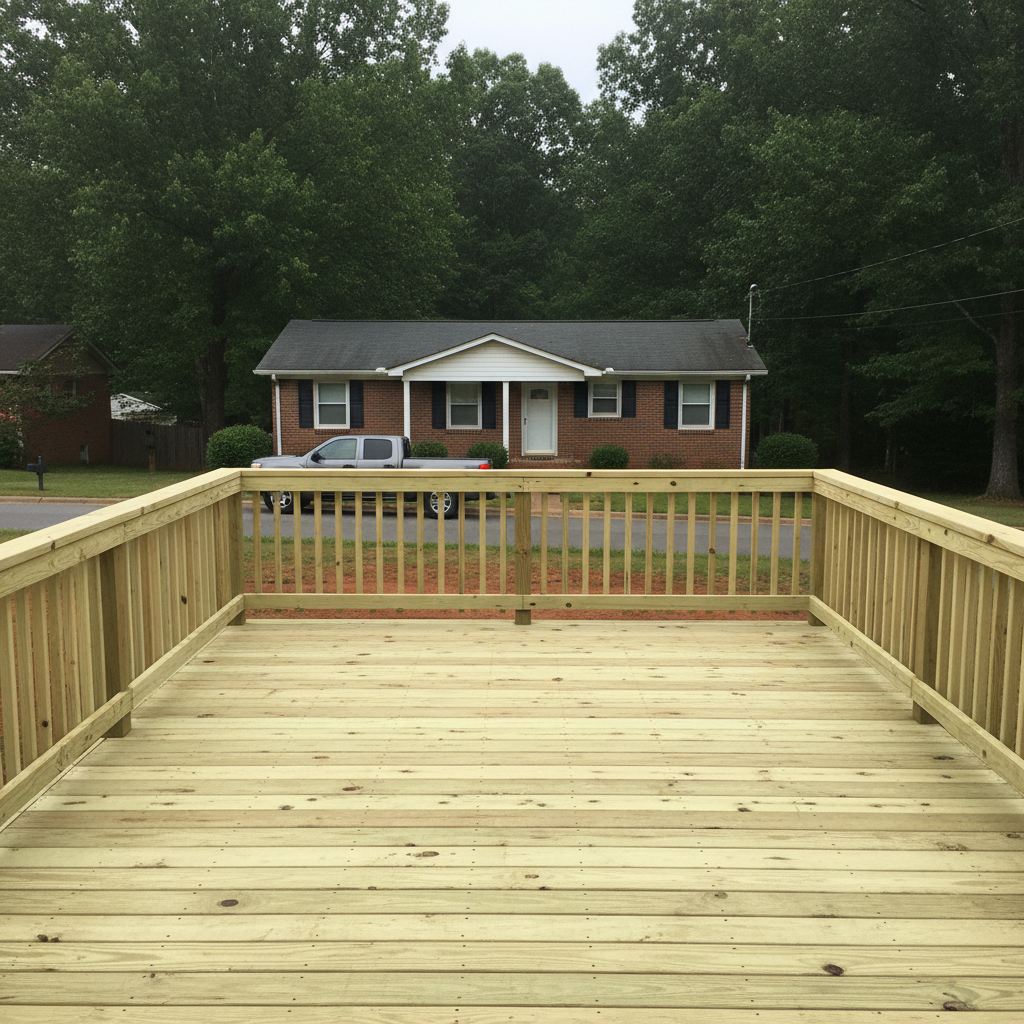
There are a lot of names in the Roswell deck-building world, and from the curb their trucks all look about the same. The difference shows up underground, in the fasteners, and in the paperwork nobody wants to talk about. Red clay doesn't forgive shortcuts, and neither does a Fulton County inspector. Here's what actually separates a builder worth hiring from one you'll be calling back in two years.
The ground decides more than the design does
Most lots around Roswell sit on Piedmont red clay. Dry, it's hard as brick. Wet, it swells and grips, and when it dries out again it shrinks away from whatever's sitting in it. That movement is exactly what you don't want under a deck footing. A footing poured on fill dirt, or on clay that hasn't been dug to undisturbed soil, will shift a little every wet season. You'll see it as a post that's suddenly a quarter inch proud of the decking, or a rail that's gone slightly out of square.
A builder who knows the area digs footings deep enough to get below the frost line and onto solid bearing soil, usually 12 inches minimum here, sometimes more depending on what the inspector wants to see on that particular lot. If a crew tells you they'll just "set posts on pavers" for a deck that's attached to the house and more than a foot or two off the ground, that's a shortcut that costs you later, not now.
Permits aren't a formality, they're a second set of eyes
Any deck attached to the house, and most freestanding ones over a certain height, need a permit through the City of Roswell or Fulton County depending on where the lot sits. That means an inspector checks the footings before concrete goes in, and checks the ledger attachment and framing before the decking boards go down. A builder who pulls permits is accepting that someone else will look at their work. A builder who tells you permits "slow things down" or that you're "fine without one" is asking you to skip the one independent check you get.
If you're in a neighborhood with an HOA, and plenty around Roswell have one, Horseshoe Bend, Martins Landing, River Oaks and others, there's often an architectural review on top of the permit. That can add a couple of weeks before anyone digs a hole. A builder who's done work in your subdivision before will already know the drill. One who's never heard of your HOA isn't disqualified, but ask how they plan to handle it.
What a real proposal actually spells out
A vague one-page quote that says "build deck, 300 sq ft, $14,000" tells you nothing. A proposal worth signing names the lumber species or composite brand, the joist spacing (16 inches on center is standard, some composite manufacturers require 12 inches to keep their warranty valid), the footing size and count, and how the ledger board bolts to the house. That last one matters more than people realize. Treated lumber reacts with plain steel, so ledger bolts and joist hangers need to be hot-dip galvanized or stainless, spaced no more than 16 inches apart along the ledger. A deck that pulls away from the house in a storm almost always traces back to a ledger that was nailed instead of through-bolted, or flashed wrong so water sat behind it for years.
Older decks in the historic streets near downtown, around Mimosa and the Mill district, were often built decades ago with just nails and no flashing at all. If you're getting a repair quote on one of those, that's usually the actual problem, not the boards on top.
What to walk away from
- No proof of insurance. If a worker falls off a half-built deck on your property and the company isn't covered, that liability can land on you.
- No written contract, or one that doesn't mention a permit at all.
- A quote that's dramatically lower than everyone else's with no explanation. Somewhere in that number, a corner is getting cut, usually footings or fasteners, the two things you can't see once the deck is finished.
- A builder who can't tell you how they're attaching the ledger board when you ask directly.
- Pressure to pay the full amount upfront before any work starts.
Questions worth asking before you sign anything
Ask how deep the footings will go and what they'll be resting on. Ask what happens if they hit a buried stump or old tree roots digging the holes, which comes up more than you'd think on lots that were cleared from old farmland decades back, especially on the older east-side streets. Ask how the ledger attaches and what fasteners they're using. Ask about timeline for staining if it's a new build with pressure-treated lumber. In Georgia humidity that wood needs to dry out before it'll take a stain, sometimes two to four months, longer if the lumber was still wet when it left the treatment plant. A builder who tells you to stain it the week it's finished either doesn't know that or isn't telling you.
Last thing: ask what the warranty actually covers, labor separate from materials, and get it in writing. A composite deck board might carry a 25-year manufacturer warranty against fading and staining, but that's worthless if the frame underneath was never built to hold up that long.
We've built and repaired enough decks around this county to know where the corners usually get cut, and we'd rather walk you through our own footings and fasteners than talk you into anything. You can see more of our deck builder work around Roswell if you want a sense of how we do it.